
Stress in Children Due to Screen Time: Hidden Causes & Natural Solutions for Indian Parents
Your child is not “misbehaving.”
Their nervous system is overwhelmed.
The real cause might be closer than you think.
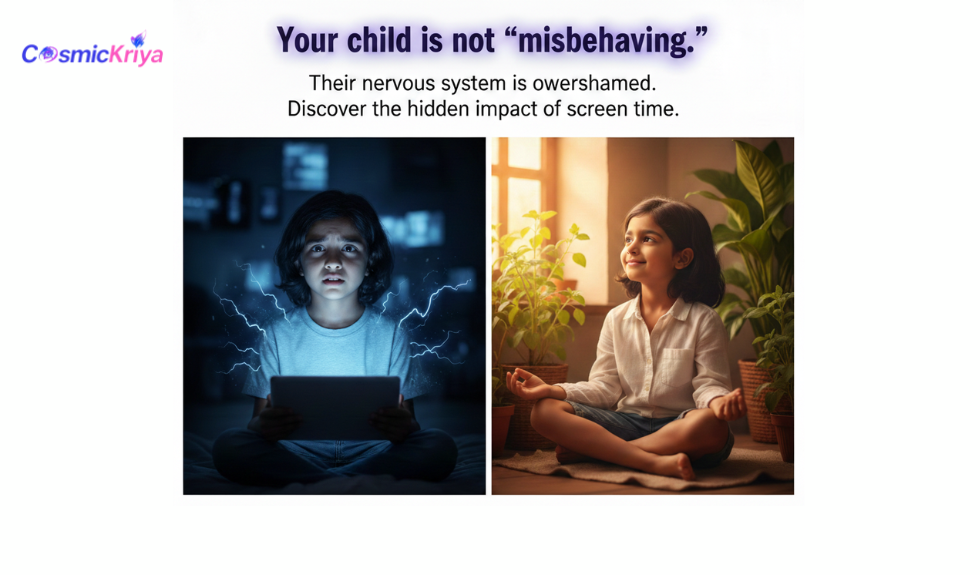
Modern childhood has changed dramatically.
Today, stress in children due to screen time is becoming one of the biggest mental health concerns for parents, especially in urban India.
Children are exposed to:
- Gaming dopamine cycles
- Constant YouTube and reels
- Academic competition
- Social comparison pressure
But the human nervous system has not evolved for nonstop digital stimulation.
According to the World Health Organization, rising screen exposure and academic pressure are contributing factors to increased anxiety and emotional dysregulation in children globally.
This is not “bad behavior.”
It is a nervous system overload.
How Screen Time Increases Stress in Children
Every notification creates anticipation.
Every swipe releases dopamine.
Every comparison creates inadequacy.
Over time, excessive screen exposure disrupts:
- Sleep cycles
- Emotional regulation
- Attention span
- Impulse control
The American Academy of Pediatrics warns that too much screen time can interfere with sleep, learning, and emotional health.
The body is designed for this cycle:
Stress → Movement → Release → Calm
Modern childhood cycle:
Stress → Screen → Suppression → Emotional Explosion
That is why we see:
- Sudden aggression
- Breaking objects
- Irritability
- Emotional numbness
- Reduced focus
These are classic child stress symptoms.
10 Major Causes of Stress in Children Today
1. Excessive Screen Time
Frequent dopamine spikes dysregulate the reward system.
2. Lack of Outdoor Play
Without physical activity, cortisol remains stored in the body.
3. Academic Pressure in India
Tuition culture, rank comparison, competitive exams — chronic performance stress.
4. Social Media Comparison
Unrealistic standards of beauty and success.
5. Over-Scheduled Routine
No downtime for emotional processing.
6. Sleep Deprivation
Blue light suppresses melatonin production.
7. Emotional Invalidation at Home
Children are corrected more than heard.
8. Hyperstimulation
Fast-paced content keeps the brain in fight-or-flight mode.
9. Reduced Family Interaction
Devices replace conversations.
10. No Nervous System Regulation Skills
Children are not taught how to calm themselves.
“When a child reacts intensely, it is rarely rebellion — it is an overwhelmed nervous system asking for regulation.”
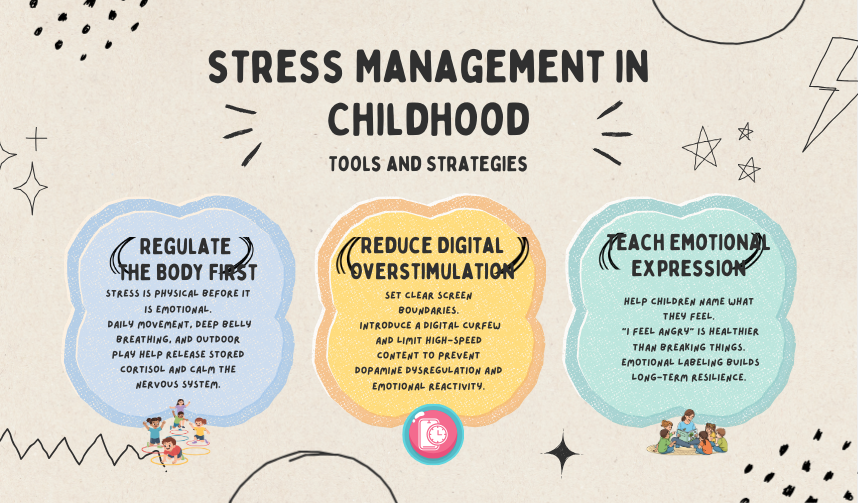
How to Reduce Stress in Children Naturally
If you are searching for how to reduce stress in children naturally, start with regulation — not punishment.
Here are evidence-aligned, practical solutions:
- Minimum 45 minutes of outdoor play daily
- 5-minute-deep belly breathing before school
- Digital curfew after sunset
- No comparison parenting rule
- Nightly family gratitude ritual
- 20-second regulation hug
- Morning sunlight exposure
- Emotional naming practice (“I feel angry”)
- Weekly nature exposure
Stress must move through the body to release.
Nervous System Regulation for Kids: The Cosmic Kriya Approach
Modern problems require structured solutions.
Cosmic Kriya introduces children to a simple 3-step nervous system regulation model:
- Breath awareness
- Body movement
- 2 minutes guided stillness
This supports:
- Emotional stability
- Improved focus
- Reduced aggression
- Better sleep
- Lower anxiety
We cannot eliminate technology.
But we can strengthen the nervous system that interacts with it.
Healthy children are not stress-free.
They are stress-resilient.
Originally published February 14, 2026